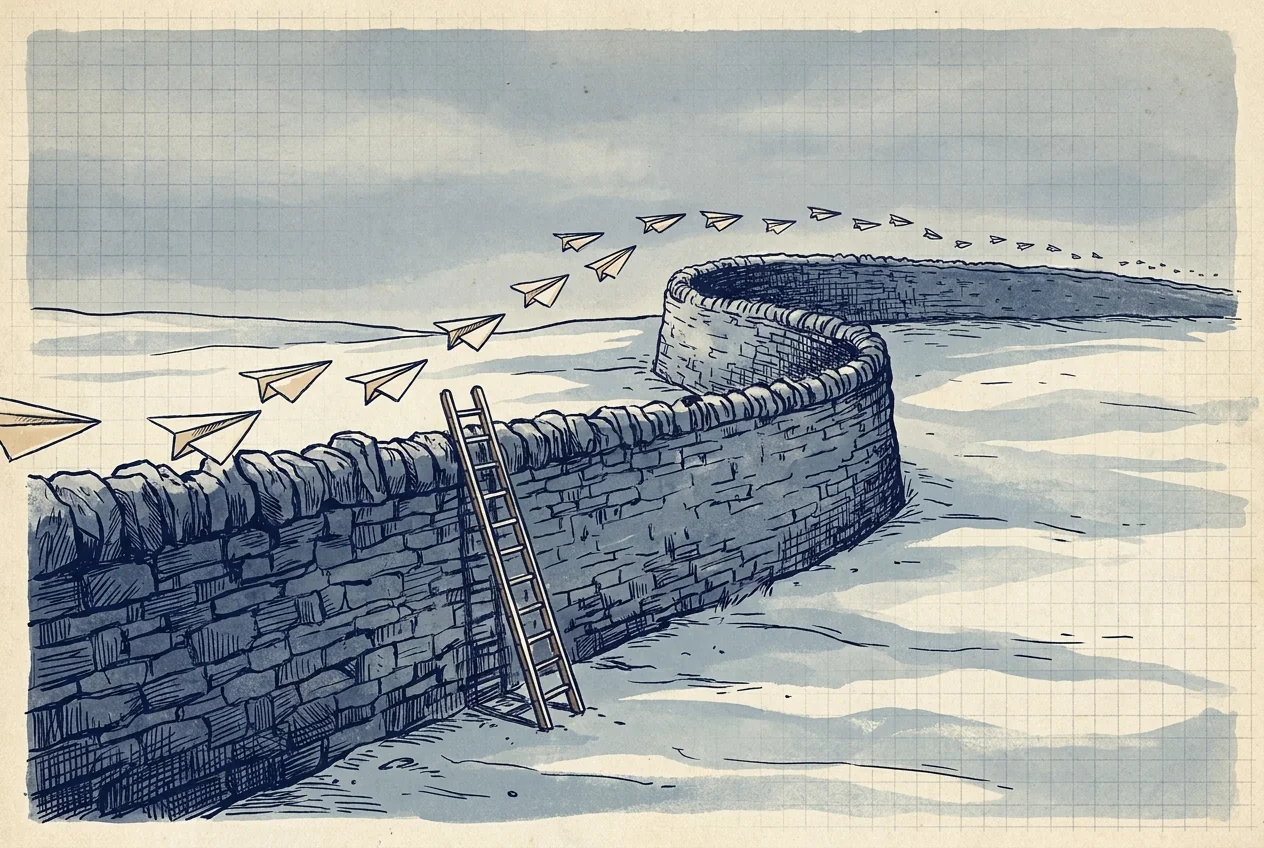
What the Great Firewall actually blocks
The Great Firewall of China, sometimes abbreviated GFW, is a set of laws, agencies, and technical systems that filter what people inside China can reach on the international internet. The most visible parts are the blocked sites: Google Search, YouTube, Facebook, Instagram, Twitter, most Western news outlets, and a long list of others. Wikipedia has been blocked in various languages at different times. The list changes without warning.
The Great Firewall is not a single wall around China. It is a set of choke points at the country's international network borders where filtering rules are applied. Domestic Chinese sites are subject to a separate set of internal rules and are not filtered by the border wall in the same way.
The three main blocking methods
Three techniques do most of the filtering.
- DNS poisoning. When your computer asks "where is twitter.com?" the answer that comes back is a fake address. Your browser talks to nowhere and times out.
- IP blocking. Traffic to the real IP addresses of blocked services is dropped at the border. Even if you knew the address by heart, packets never arrive.
- Deep packet inspection. Filters read the shape of your traffic to spot the fingerprints of tools like OpenVPN or plain Tor and drop those connections mid-stream.
On top of these, the Great Firewall does active probing. When it sees a suspicious connection, it can send its own probe traffic to check whether the server on the other end is a censorship-circumvention tool. If yes, that server can be added to a block list.
How people leap the wall
The Chinese verb for using a circumvention tool is fan qiang, which literally means "flip the wall". People do it every day. The most common tools are commercial VPNs (many of which are technically illegal but tolerated in practice), Shadowsocks — a simple SOCKS5-style tunnel designed specifically to look like normal encrypted traffic — and Tor with bridges and pluggable transports. See our comparison of VPN, Tor, and Psiphon for how these tools differ.
Shadowsocks in particular has an interesting history. It was written by a Chinese engineer who published the code on GitHub and later took it down under government pressure. Forks kept it alive. Today it is one of the most used circumvention tools in China, in part because it is simple, in part because it is easy to run on a small personal server abroad.
The cat-and-mouse of pluggable transports
When a tool becomes popular, the Great Firewall learns to spot it. When the Great Firewall learns to spot it, the tool adds a new disguise. This is what "pluggable transports" means in the Tor world — small modules that wrap Tor traffic to look like something else. Obfs4 makes Tor look like random noise. Meek makes it look like it is going to a big cloud provider. Snowflake bounces traffic through volunteer browser tabs.
Each of these transports has a lifespan. The Great Firewall spots the pattern, blocks it, and the tool ships a new one. This is why the versions of these apps change often and why researchers who study Chinese internet controls call the Great Firewall an "arms race" rather than a fixed system. Neighboring countries like Iran watch and borrow the techniques both sides use.
Why the Great Firewall keeps getting harder
Over the last decade the Great Firewall has moved from crude DNS-level blocks to sophisticated deep packet inspection and active probing that spots even well-disguised traffic. It has also been paired with tighter domestic controls: real-name registration for social media, aggressive takedowns of circumvention servers hosted inside China, and legal pressure on people who sell or run VPNs. The upshot for the average person inside the country is that reaching Google or Wikipedia takes work, and the tools that work today may not work next month. Understanding how the Great Firewall works is the first step to understanding what it takes to get past it.