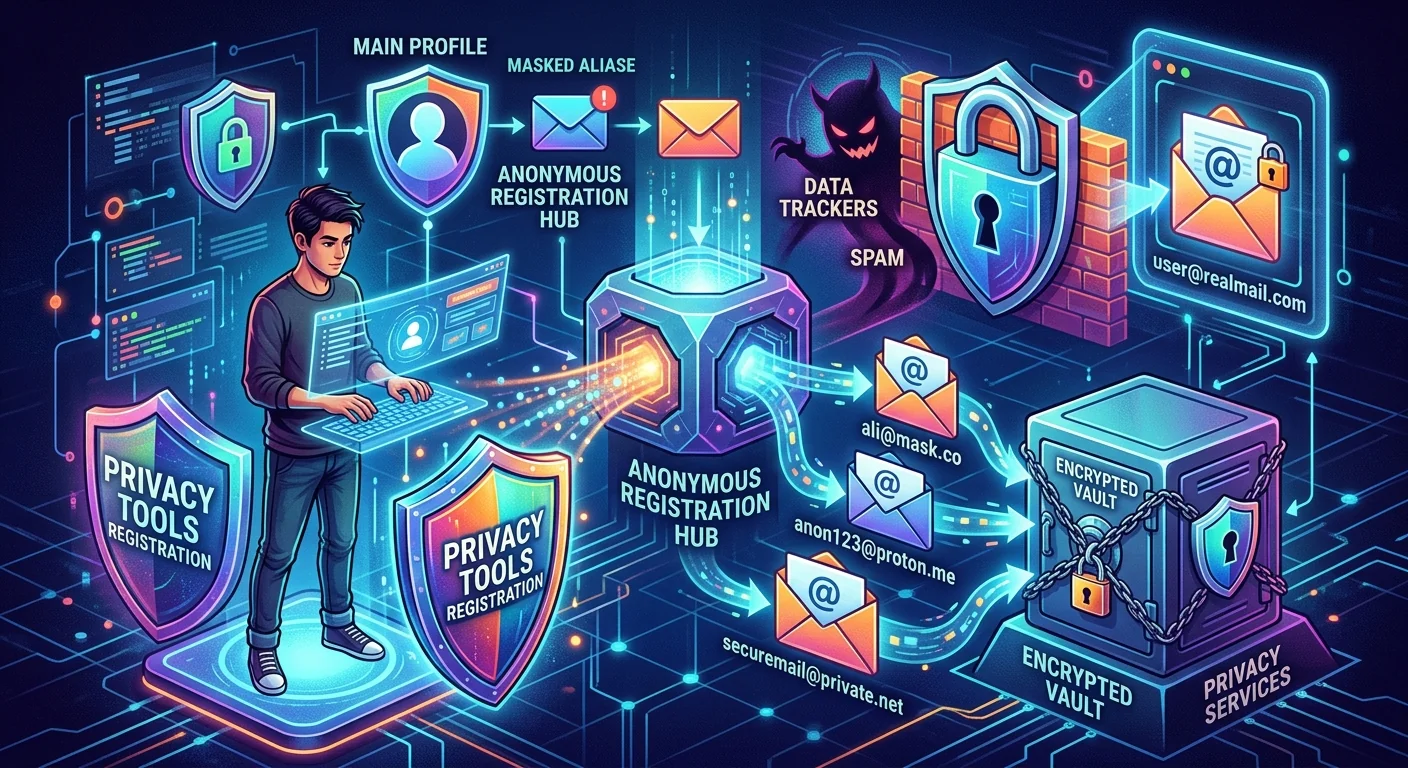
You download a VPN. You find an encrypted messaging app. You locate a circumvention tool that routes around your government's content filters. Then the sign-up screen loads, and it asks for your email address. That single field can unravel the protection you were building. Your real email is a thread that ties your identity to your security software, and in the wrong hands, that thread gets pulled.
Staying Unlinkable at Sign-Up
- Your registration email creates a permanent record linking your identity to your security tools
- Service providers in many countries are legally required to hand that data to authorities on request
- A disposable email address breaks the link between your real identity and your account without any technical expertise
- Using a separate throwaway address for each tool limits the damage if one account is ever exposed
- The entire setup takes minutes and costs nothing
The Privacy Paradox at Sign-Up
Privacy tools are built to protect you. Most of them also require you to create an account before you can use them. That account needs an email address. The very act of adopting a security tool can therefore create a new exposure point before you have sent a single message or made a single connection.
This is not a hypothetical problem. Governments operating in high-surveillance environments have obtained user account data from VPN providers, messaging platforms, and circumvention services. They do it through legal demands, through data breaches they enable, and through direct pressure on companies with local operations. An email address attached to a VPN account becomes a data point in an investigation.
Journalists covering sensitive stories face a specific version of this risk. A source might reach out through a secure channel. But if the journalist signed up for that channel using a work email, a subpoena served to the service provider can expose the journalist's identity. The tool did its job. The account registration undermined it.
What Your Email Address Actually Exposes
An email address is not just a login credential. It is an identity anchor. For most people, an email address includes a recognizable username or real name. It links to a recovery phone number. It connects to a billing profile if the account holder has ever paid for anything online. It may be the same address used for years across dozens of services.
Registering for a VPN with your real email gives the provider a way to link your subscription to your offline identity. If that provider receives a legal order, they can hand over your email address, your registration timestamp, and often your payment records. Even providers that keep no traffic logs still hold account records. Those records are enough.
Metadata alone tells investigators a great deal. The fact that a specific email address is attached to a VPN account, registered at a specific time, from a specific country, is information. That information can be combined with other data sources to build a profile. Your browsing history does not need to be exposed for your account metadata to cause harm.
How Registration Records Become a Target in High-Surveillance Contexts
Services registered in certain jurisdictions operate under laws that require compliance with government data requests. Some providers publish transparency reports and disclose how often they hand over records. Others comply quietly. A few have shared user data in ways that had direct consequences for the people involved.
Grounding your approach in threat modeling guidance clarifies why account metadata can endanger people even when their actual communications are fully encrypted. The content of your messages may be unreadable to any observer. The existence of your account, the email address tied to it, and the timing of your activity are all readable. Your security posture is only as strong as its weakest point, and for many people, the registration step is that point.
There is also the problem of data breaches. A service provider you trust today may be breached tomorrow. If your real email address sits in their database, it now belongs to whoever accessed that database. Attackers cross-reference email addresses from multiple breach datasets to identify which services a person uses. Your VPN account email appearing in a breach record is not a neutral event.
Building a Registration Workflow That Leaves No Trail
The goal is to ensure that no account you create for a security tool can be traced back to your real identity. The fix does not require advanced technical skills. It requires a short workflow that you run each time you sign up for a new privacy tool.
- Generate a throwaway email address that requires no personal information to create
- Use that address only to register for the specific tool you are signing up for, nothing else
- Create a fresh throwaway address for each additional tool rather than reusing one
- Access the sign-up page over Tor or a trusted circumvention tool so your IP address is not logged at the point of registration
- Use a payment method that does not link to your real name if the service charges a subscription fee
None of these steps requires specialist knowledge. Each one removes a specific data point that could otherwise link your identity to your security software.
Generating a Throwaway Address for Tool Sign-Ups
The most accessible option for most people is a browser-based disposable inbox. You visit a site, receive a randomly generated address in seconds, and paste it into whatever sign-up form you are filling out. The inbox loads in your browser. When the confirmation email arrives, you click the link. The account is verified. The throwaway address has served its purpose and can be discarded.
Visiting an anonymous email service generates a working inbox in roughly thirty seconds, with no account required, no password set, and no name attached. There is no record connecting your real identity to that inbox. Even if the service you registered with is later compelled to hand over account data, all the record shows is a temporary inbox address that pointed to no one.
One thing to keep in mind: some VPN and messaging services recognize disposable email domains and block sign-ups that come from them. If that happens, the alternative is to create a privacy-focused email account with a provider that does not require a phone number, accessed entirely over Tor during setup. That takes a few extra minutes but achieves the same result. The account becomes a clean registration address with no link to your real identity.
One Address Per Tool, Not One for All
Using a single throwaway address for every security tool sign-up reduces the protection you get from the strategy. If that address can be connected to a real identity through a separate data breach or cross-referencing investigation, every tool you registered with is now linked to you.
Compartmentalization is the answer. Create a fresh throwaway address each time you sign up for a new tool. A compromise of one account then does not cascade into an exposure of your entire security setup. The effort is minimal. The protection added is real.
The same logic applies to payment. Paying for a VPN subscription with a credit card tied to your name creates a direct record linking you to the account regardless of what email address you used during registration. For paid services, look into cryptocurrency payments or prepaid cards purchased with cash. The right approach depends on your threat level and what is accessible where you are.
Handling the IP Address Problem at Registration Time
A disposable email handles one exposure point. Your IP address at the moment of registration is another. Signing up for a service from your home connection or workplace network gives the provider a log entry that can trace back to your internet service provider, and from there to you.
Registering for new accounts over Tor closes that gap. Tor routes your connection through multiple relays before it reaches the destination, masking your real IP address. If Tor is blocked in your region, use a working circumvention tool first to reach the Tor network, then proceed with the sign-up from there.
The order of operations matters. Get Tor running before you open the sign-up page. Then generate the throwaway address. Then complete the form. Do not register from your regular connection and switch to Tor afterward. By that point, the registration log already contains your real IP address and the damage is done.
The Sign-Up Screen Is Part of Your Security Model
Most people treat security tools as the protection layer. They are. But the account you create to access a tool is also part of your security model. A VPN with strong encryption and a verified no-logs policy still exposes something if the account registration is tied to your real email address, submitted from your home network, at an identifiable time of day.
Each step in your digital life creates records. Those records can be assembled into a picture of who you are and what you are doing. Breaking the connections between those records, starting at the registration step, costs almost nothing in time or effort and adds a meaningful layer of protection that most people skip entirely.
For journalists, activists, and NGO workers operating in environments where using privacy software could itself become evidence, these steps at sign-up are not optional extras. The tools you choose matter. How you adopt them matters just as much. Getting that part right takes thirty seconds and a throwaway inbox.