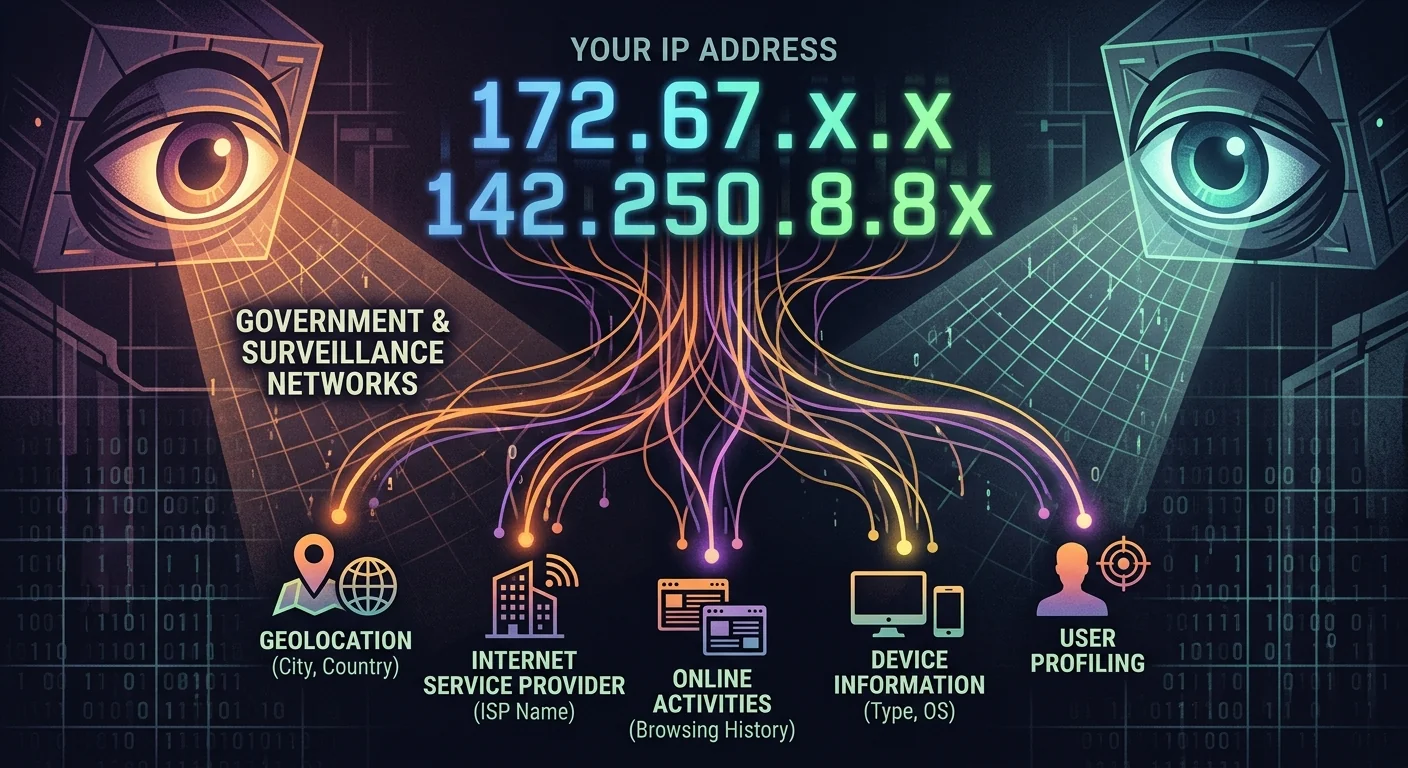
Every time you load a webpage, your device announces itself. It sends a numerical label, your IP address, that travels with every request you make online. Most people treat this as harmless background noise. For activists, journalists, and dissidents operating under watchful governments, that small piece of data can be the thread that unravels everything.
This is not a hypothetical. It is a pattern with documented victims and documented methods. Understanding exactly what your IP address exposes, and what to do about it, is not just a technical exercise. It is a practical matter of safety.
Your IP address is not anonymous, and the distance between "hard to trace" and "easily traceable" is far shorter than most people realize.
- Governments routinely compel internet service providers to hand over subscriber records tied to specific IP addresses and timestamps.
- Your IP exposes your approximate location, your internet provider, and a timestamped history of your online activity.
- Knowing what you are currently leaking is the first and most important step toward protecting yourself.
What an IP Address Actually Is
The term gets thrown around a lot, but it helps to be precise. An IP address is the numerical label assigned to your device whenever it connects to a network. Think of it as a return address on a letter. Every packet of data your device sends carries this label, so the server on the receiving end knows where to send the reply.
There are two versions in use today. IPv4 addresses look like four numbers separated by dots, such as 203.0.113.7. IPv6 addresses are longer, designed to support the sheer number of devices now connected globally. The format matters less than the function. Both versions serve the same purpose: they identify your connection point on the internet.
What makes this significant for surveillance is that IP addresses are not randomly assigned. They are allocated in blocks to specific internet service providers and organizations. That allocation is publicly documented through registries. Anyone can look up which company owns a given IP range within seconds.
The Information Your IP Address Puts on the Table
Your IP address does not contain your name. It does not hold your home address. But it contains enough to begin building a picture of who you are and where you are.
Your internet service provider is immediately visible. The moment a server receives a request from your IP address, it can look up the company that assigned that address to you. That company has your account details on file, including your name, billing address, and payment information.
Your approximate physical location is also readable. IP geolocation databases map address ranges to cities and regions. The precision varies, but city-level accuracy is common. For someone living in a country with a repressive government, knowing that a particular IP address belongs to a specific city is often enough to significantly narrow down a target.
Connection logs add a time dimension. Websites and platforms record the IP addresses that contact them, along with timestamps. This creates a trail showing when you were online, how often, and what you accessed. Those logs can be stored for months or years. They do not expire just because you stopped visiting a site.
How Governments Move from an IP Address to a Real Person
The gap between an IP address and a physical human being is smaller than most people imagine, particularly in countries without independent judicial oversight of government requests.
The process generally works like this. Authorities identify an IP address connected to activity they consider threatening. This could be a social media post, an article, a message sent through a platform, or a file downloaded from a particular source. They then issue a request to the internet service provider that owns that address, asking for the subscriber record associated with it at the relevant timestamp. The ISP returns a name, an address, often a phone number.
In many democratic countries, this process requires a court order. In authoritarian states, it often requires nothing more than an informal request, or a standing legal obligation that forces ISPs to cooperate with no independent review. Iran, Russia, China, Belarus, and several other countries have laws mandating that providers retain user data and hand it over to intelligence or law enforcement agencies on demand.
Documented Cases Where IP Logs Led to Arrests
Press freedom and human rights organizations have recorded cases across multiple countries where IP address data contributed directly to arrests and prosecution.
In Iran, bloggers and journalists have been traced through the IP addresses attached to content critical of the government. Some of those individuals were using internet cafes, hoping the shared connection would obscure them. Authorities in several cases subpoenaed the cafe's session records to identify who was logged in at the relevant time.
In Russia, domestic ISPs operate under SORM, a technical surveillance architecture that requires them to install equipment giving the Federal Security Service direct access to user traffic without individual warrants. The IP address in this environment is one layer of a much deeper surveillance apparatus, but it often serves as the starting point.
In Belarus, particularly after the 2020 protests, authorities used digital evidence gathered from social platforms, messaging services, and local provider records to identify and prosecute thousands of protesters and organizers. People who believed they were posting anonymously were not. They had not understood what their connections were revealing.
These cases share a common thread. Users who did not understand their exposure took risks they did not know they were taking.
Seeing Your Own Exposure Before You Change Anything
Abstract warnings about IP tracking rarely change behavior. Seeing your own data laid out plainly does. Before making any changes to how you connect, it is worth checking what information your current connection is broadcasting to every server you contact.
The first practical move is to hide my IP from the services logging every request, but doing that effectively means first understanding what you are currently exposing. A connection check shows your IP address, the ISP attached to it, your estimated location, and sometimes additional technical details about your connection type. For many people, seeing their city and provider displayed without any action on their part is enough to make the risk feel real rather than theoretical.
VPNs as the First Layer of Protection
A Virtual Private Network routes your internet traffic through a server operated by the VPN provider. The websites and services you contact see the VPN server's IP address, not yours. Your ISP sees encrypted traffic going to that server, but cannot read the contents or identify which sites you are visiting.
This provides meaningful protection in many situations, but it carries a significant caveat. You are now trusting your VPN provider the way you previously trusted your ISP. If that provider keeps logs and operates in a country that cooperates with your government, you may have moved the problem rather than solved it.
Choosing a VPN with a verified no-logs policy, based in a jurisdiction with strong legal protections, makes a genuine difference. The key word is "verified," meaning an independent audit has confirmed the policy is actually implemented, not just advertised in marketing copy.
Tor: The Option Built for High-Risk Environments
Tor routes your traffic through a chain of volunteer-operated servers called nodes. Each node knows only the previous and next hop in the chain. No single node has a complete picture of both who you are and what you are accessing. This design makes traffic correlation attacks extremely difficult, even for well-resourced state actors.
Security researchers and civil liberties organizations have published detailed guides on protecting digital identity for those at greatest risk, and Tor appears consistently as the recommended tool for worst-case scenarios involving state-level adversaries. It is slower than a VPN, and some services block it entirely. But for the highest-risk situations, it offers a qualitatively different level of protection.
Encrypted DNS: The Privacy Gap Most Users Never Think About
When you type a website address, your device first sends a query to a DNS server asking it to translate that name into an IP address your device can connect to. By default, these queries travel in plaintext to your ISP's servers. That means your ISP can see every domain name you look up, even when your actual traffic is encrypted.
Encrypted DNS protocols, specifically DNS-over-HTTPS and DNS-over-TLS, encrypt these lookups so they cannot be read in transit. This closes a gap that persists even for some VPN users, because certain VPN configurations do not fully protect DNS traffic. Combined with a VPN, encrypted DNS means your ISP can see that you are connected to a VPN server, but cannot log what sites you are looking up or visiting.
Matching the Right Tools to Your Actual Threat
These tools are not one-size-fits-all. A journalist investigating organized crime in a country with a functioning court system faces a different threat than an activist in a state with no independent judiciary and mandatory ISP data retention. Threat modeling, the practice of thinking clearly about who your adversary is and what resources they have, is what connects the abstract risk to a concrete response.
Here is what each layer primarily addresses:
- VPN: Masks your IP address from websites and services; encrypts traffic content from your ISP's view
- Tor: Prevents any single point in the network from connecting your identity to your destination; strongest for state-level adversaries
- Encrypted DNS: Stops your ISP from logging the domain names you look up, even when other traffic is protected
- All three combined: Closes the most significant gaps simultaneously for users in high-surveillance environments
For someone posting on a domestic platform in a country with mandatory data retention laws, a VPN alone may not be enough. For someone who primarily reads international news and wants basic privacy from their ISP, a VPN with encrypted DNS is likely sufficient. The tool has to match the threat.
What the Trail You Leave Behind Actually Means
An IP address is a small piece of data. It fits in a log entry shorter than a text message. But it connects to a name, a physical address, a billing record, and a timestamped history of online activity. Governments in restrictive regions have built prosecution cases on far thinner evidence than this.
The tools described here are not theoretical. VPNs, Tor, and encrypted DNS are widely used, well-documented, and accessible to non-technical users. None of them requires specialized knowledge to set up. What they require is a clear understanding of the problem they are solving.
Digital safety is not something you achieve once and then forget. It is a set of habits and tools that you adapt as your situation changes. The first step is always the same: understand what you are currently exposing. The second is choosing the layer of protection that fits the threat you actually face. And the third is staying aware, because surveillance tools and the tactics behind them do not stay static.
The thread that connects your IP address to your front door is shorter than you think. The good news is that it can be cut.